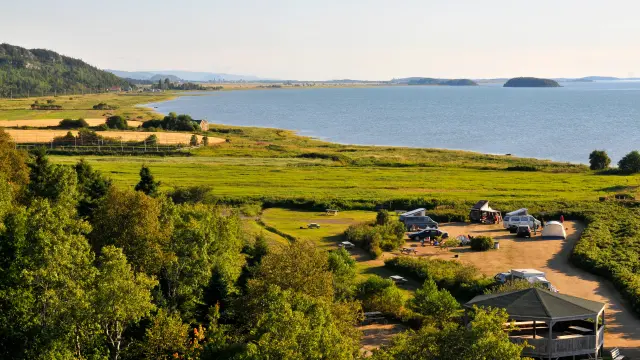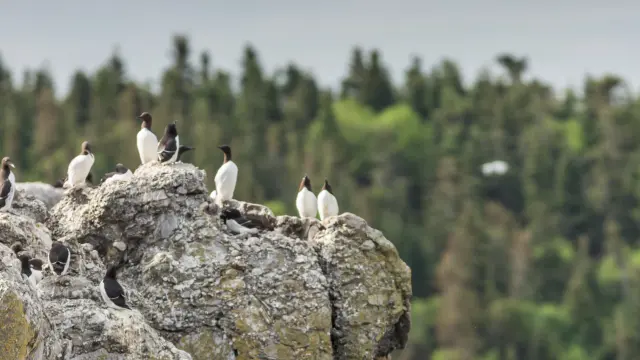
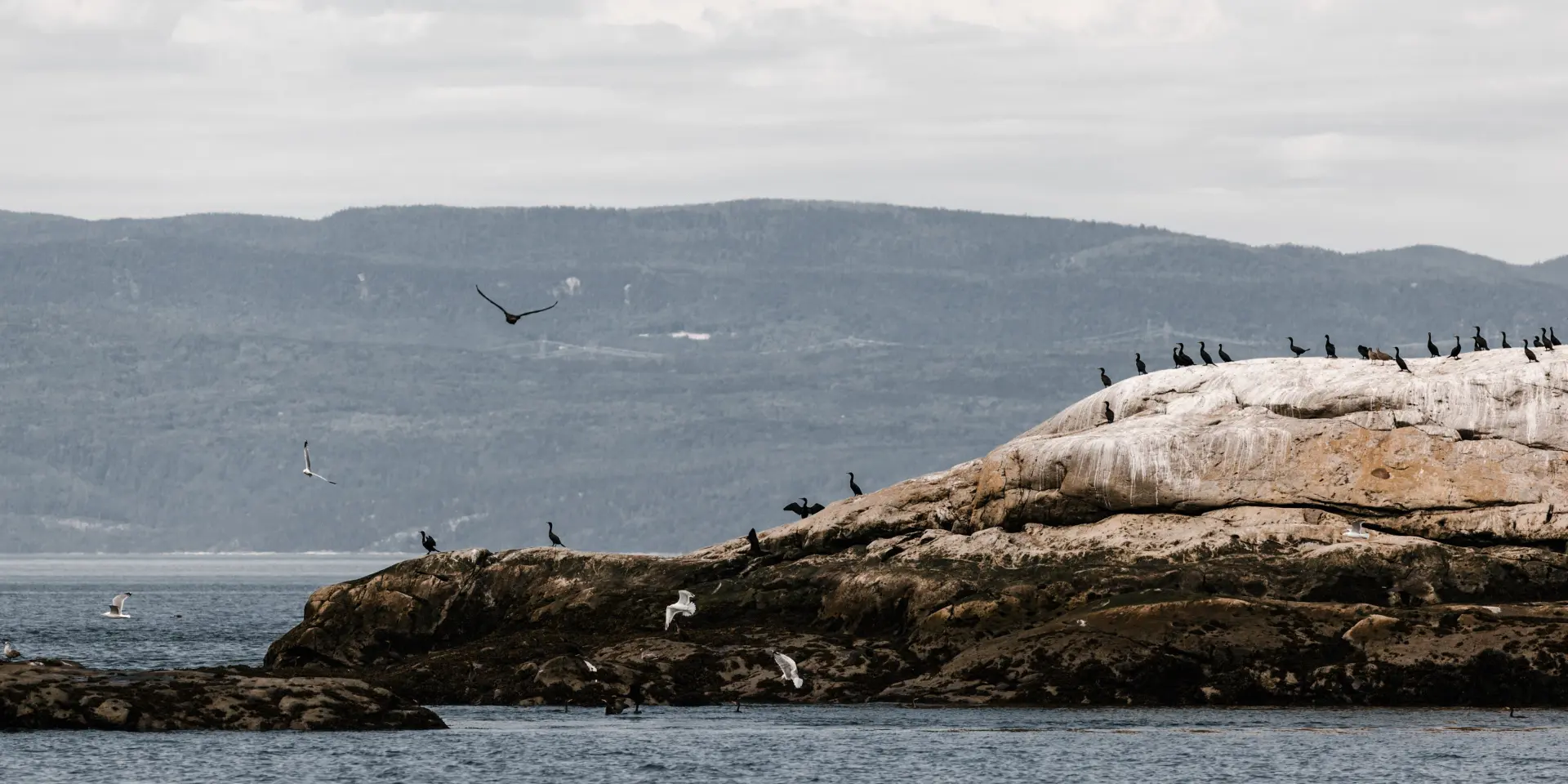
A flock of birds in the St. Lawrence Islands near Rivière-du-Loup in the Bas-Saint-Laurent region
©

Société Duvetnor, Bas-Saint-Laurent

|

BESIDE/Catherine Bernier

Bird-Watching Itinerary in Bas-Saint-Laurent

6 days | 180 km (110 mi.)  La Pocatière to Rimouski

Whether on an island or in a forest, national park or marine protected area, you will be able to admire hundreds of bird species during your vacation in Bas-Saint-Laurent.

This bird-watching itinerary will take you along the coast from La Pocatière to Rimouski, but you will also find many birding sites in the region’s high country, including in the Le Témiscouata sector, where you can observe impressive bald eagles, among other species.

Featured species
Common eiders are the largest breeding ducks in Québec. Known for producing highly insulating down, these birds can be observed in several places in Bas-Saint-Laurent, particularly in Parc national du Bic, in the Le Kamouraska sector, on Île aux Lièvres and Île du Pot à l’Eau-de-Vie and elsewhere in the Saguenay–St. Lawrence Marine Park.

Plan interactif : 3 lieux répertoriés.

  • Lieu sans nom
  • Lieu sans nom
  • Lieu sans nom

Plan interactif : 4 lieux répertoriés.

  • La Pocatière to Rivière-du-Loup
  • Rivière-du-Loup
  • Rivière-du-Loup to Rimouski
  • Rimouski

Day 1 La Pocatière to Rivière-du-Loup 70 km (45 mi.)

La Pocatière tidal flats 
Easily accessible on foot or by bike from La Pocatière, these tidal flats are a feeding ground for several bird species. Among others, Canada geese, American black ducks, greater scaups, black scoters and common goldeneyes can be spotted here.

Kamouraska tidal flats 
Visit the SEBKA park where you can hike several trails to various lookouts and observation decks to see seabirds, birds of prey and forest birds. Snow geese, Canada geese and various species of ducks are commonly sighted on the tidal flats during migration periods.

Days 2 and 3 Rivière-du-Loup

Île aux Lièvres (Hare Island) and Île du Pot à l’Eau-de-Vie (Brandy Pot Island) 
Over 150 seabird species are regularly recorded in the Saguenay–St. Lawrence Marine Park. Once the nesting season is over, you can visit these two islands within the marine park off Rivière-du-Loup, which act as a sanctuary for many bird species. Société Duvetnor, the organization that protects these islands, offers boat trips to visit them, during which an interpreter guide will share information about the species you observe. Double-crested cormorants, great blue herons, black-crowned night herons, common eiders, black-legged kittiwakes, razorbills and black guillemots nest all over these islands.

Day 4 Rivière-du-Loup to Rimouski 110 km (70 mi.)

Gros-Cacouna marsh (Parc côtier Kiskotuk) 
Located near the port of Gros-Cacouna within Parc côtier Kiskotuk, this marsh attracts several thousand seabirds and has nearly 4 km (2.5 mi.)of trails, two observation towers and a bird blind. Some of the species you may see include snowy egrets, black-bellied plovers, short-billed dowitchers, green-winged teals, double-crested cormorants, various species of diving ducks and even American white pelicans.

Île aux Basques 
Located off Trois-Pistoles, this island is part of a migratory bird sanctuary where you can observe about 230 species of birds, including common eiders and great blue herons. The only way to visit it is by going on a guided boat excursion with Société Provancher, departing from the Trois-Pistoles wharf.

Days 5 and 6 Rimouski

Parc national du Bic 
Every spring, bird watchers gather at the Raoul-Roy lookout in Parc national du Bic to observe thousands of birds of prey migrating to their nesting sites in northern Québec. In addition, the park’s bays and coves are ideal spots to observe some 10,000 pairs of common eiders as well as many other species of seabirds.

Rimouski marsh 
Located along the Le Littoral trail west of the mouth of the Rimouski River, this marsh is a feeding and staging area for many bird species, including American wigeons, green-winged teals, great blue herons, snow geese, savannah sparrows and Nelson’s sparrows (a species likely to be designated as threatened or vulnerable in Québec). A few species of birds of prey, including the peregrine falcon and sharp-shinned hawk, have also been sighted here.