The Québec maritime Blog

-
Havre Aubert Island
Mathieu Dupuis
Architecture and History: A Journey Through Time in Eastern Québec
Dear Eastern Québec,
I’m writing this letter to express my gratitude to you for preserving your rich architectural heritage to this day. What would a photo of the Îles de la Madeleine be like without the Islands’ colourful houses dotting valleys lined with red cliffs? Or Natashquan without the Les Galets fishing buildings clinging to the rocks along the sea? Or the many picturesque villages of your four regions without their majestic churches…?
But where do all these influences that have shaped the architecture of your buildings come from? I’ve been told that your lush and wild lands bursting with natural riches have always attracted adventurers from overseas. They took part in the fur trade and cod fishing, then settled here in waves. After surviving battles, journeys and challenges, they built shelters, houses and villages. We can still see traces of their passage and imagine the pages of their lives. It’s a joy to admire the buildings they left behind and even more so to be able to visit them!
Colourful Acadian-style houses adapted to the natural elements

Inspired by Acadian architecture, houses in the Îles de la Madeleine are unusual in that they are front-gabled. This distinct architectural design protects Islanders from rain and snow sliding off roof slopes. And because the Islands are sometimes buffeted by strong and violent winds, this isn’t the only adaptation to the climate that characterizes these dwellings. Fishers built their homes out of weather-resistant cedar shingles, near coves, with doors that open outwards. In addition, to save wood, which isn’t an abundant natural resource in this region, the oldest houses are rather modest in size. Today, they’re painted a variety of bright colours, giving the archipelago’s landscapes their unique and poetic character. But these colours are apparently not just decorative. It’s said that they once served as landmarks for fishers out at sea…
In the La Baie-des-Chaleurs sector, Acadian settlement also influenced local architecture. Many of the houses are small, square-cut log homes with gable dormers, often ornamented with bull’s-eye windows, lace friezes and octagonal porch posts.
Functional or refined styles, reflecting the era and social status
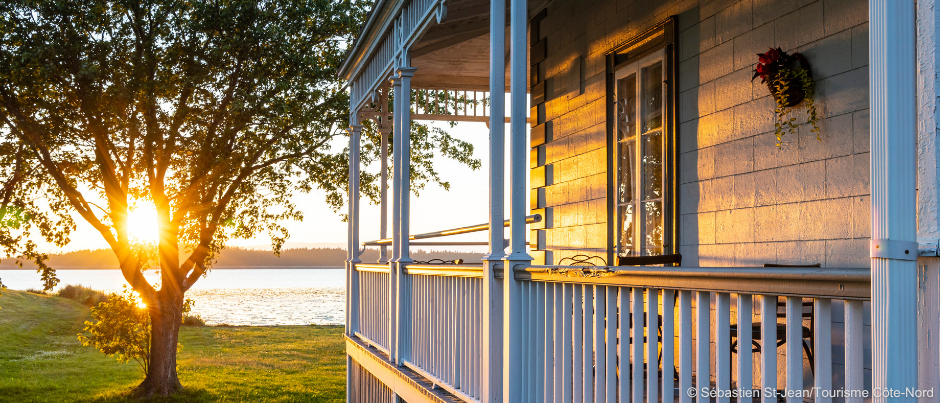
As you travel through the maritime regions of Québec, you’ll find many examples of residences whose architectural features will allow you to identify their style.
Flared eaves are an architectural feature typical of houses built on the south shore of the St. Lawrence between 1820 and 1880. Although effective in deflecting rainwater from a building’s sides and walls, their curved shape is above all very graceful. This touch of refinement is particularly evident in the Kamouraska area in Bas-Saint-Laurent, at the Giauque House, Michel-Cordeau-dit-Deslauriers House and Sainte-Anne-de-la-Pocatière train station.
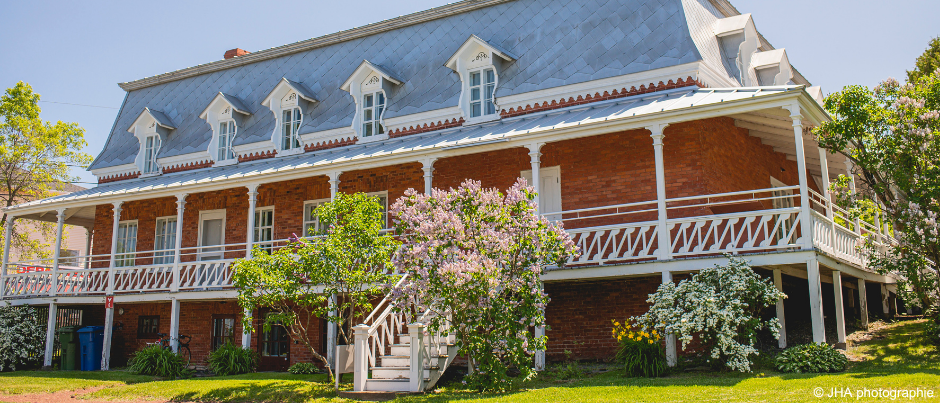
Victorian architecture is a series of architectural revival styles from the mid- to late 19th century. One outstanding example is the refined Fraser Manor in Rivière-du-Loup (Bas-Saint-Laurent). Built in 1829, it was transformed in 1888 in the Queen Anne Revival style and features several characteristics specific to this style: an ornately detailed asymmetrical façade, a corner turret, a half-hipped gable over the entrance and the finely worked porch balusters. Highly prized by Québec’s prosperous English-speaking community, this style became a true symbol of upper-class residential architecture. A visit to the Fraser Manor will transport you back in time to discover the daily life of the family that lived there for over 150 years.

In Côte-Nord, you’ll find a magnificent example of a residence built in the French-inspired Second Empire style. Built on a rocky promontory in Baie-Johan-Beetz in 1899, the Johan-Beetz House features a red mansard roof and a porch that wraps around the house on three sides. The symmetrical composition of the façade, the central main entrance topped by a large dormer window forming the gable and the details of the ornate wooden porch are all representative of this style. The architectural signature of this building is a testament to the social standing of the Belgian aristocrat who owned it.
The architecture of some of the houses on the Îles de la Madeleine has been influenced by Loyalists from New England, who left their mark on buildings with characteristics specific to the Anglo-American style. Among these distinctive features are gambrel or jerkinhead roofs, shed dormers and detailed wooden ornamentation.
When sea trades shape architecture

The fishing industry also left its mark and influenced the architecture of many buildings in the maritime regions of Québec. Gaspésie has preserved a complex of cod fishery buildings that you can visit today at the Paspébiac National Historic Site. These buildings are characterized by their vernacular wooden construction with a rectangular layout, red and white details, and cedar shingle roofs. Two simple stone buildings feature flared eaves. The crown jewel of this site is the Le Boutillier warehouse, one of the largest fishing building ever built in North America, which is five storeys high and features large windows on a gable wall.

Here are some other fishing sites worth visiting on your vacation:
- Located in Percé (Gaspésie), the red and white Le Chafaud building is a former warehouse that was once used to store and dry cod on salt beds. Today, the building houses the Discovery Centre in Parc national de l’Île-Bonaventure-et-du-Rocher-Percé.
- The La Grave heritage site (Îles de la Madeleine) is made up of a cluster of wooden buildings built along a small pebble beach that were originally used for traditional fishing activities. These structures, which are very similar in appearance, include various warehouses and sheds with shingled gable roofs.
- Les Galets in Natashquan (Côte-Nord) is also a heritage site consisting of small wooden buildings that were used for storing fishing gear and for salting and drying cod, built around 1855 by Acadian pioneers.
- The fishers’ houses found on the Lower North Shore (Côte-Nord) in villages where fishing communities have settled, including Kegaska, Chevery, Harrington Harbour and Tête-à-la-Baleine, have a charm of their own.
From modesty to opulence: An exceptionally rich and sacred heritage
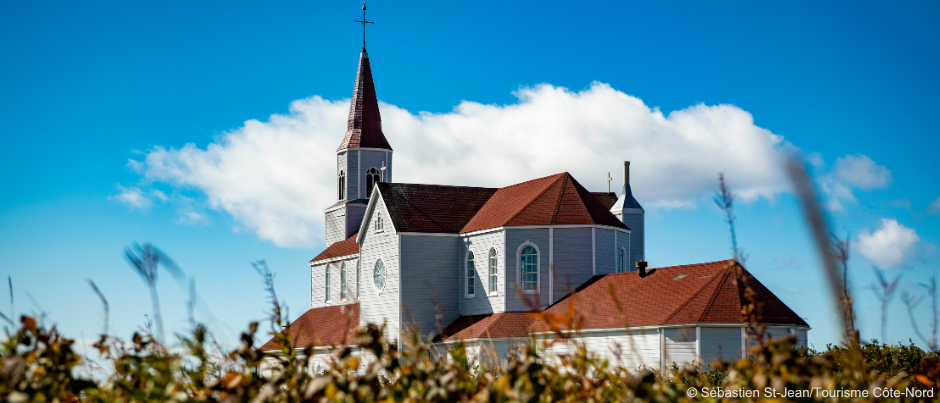
I cannot conclude this blog post without mentioning the importance of religious buildings, which have left a deep mark on the landscapes of Eastern Québec. Every small village has at least one church, if not more! These buildings are the pride of the community and may feature some very surprising architectural elements. A few worth highlighting in Côte-Nord include the Tudor-style Anglican Church of St. Andrew and St. George in Baie-Comeau; the church in Rivière-au-Tonnerre, which features a sculpted vaulted ceiling; and the charming Tadoussac Chapel in Tadoussac, which was built between 1747 and 1750, making it the oldest wooden church still standing in Canada. Another church worth mentioning is the impressive Saint-Pierre Church in La Vernière in the Îles de la Madeleine. All these buildings bear witness to a variety of architectural influences and the central role that religious heritage has played in the soul of our regions.
As you can see, exploring the architectural heritage of Eastern Québec is a great way to discover fascinating stories about local communities as well as local expertise and a way of life shaped by the sea. Travel the roads and shores of these regions, admire picturesque villages and let yourself be transported back in time as you discover the origins of these buildings and the daily lives of the people who shaped them.
If you liked this article, you might also like...
Author Jasmine Nadeau

Jasmine Nadeau savours life with humour, passion and gentleness. A lover of animals, nature, colours and words, she writes or paints in her studio with her cat nearby and her faithful Great Dane lying at her feet. She’s had a special place in her heart for Québec by the Sea since she spent her summers as a child fishing for smelt along the shore in Notre-Dame-du-Portage. Later, as a blogger, she travelled throughout the maritime regions of Québec, sharing her fishing stories, nature adventures, foodie getaways, favourite hotels and best finds.
(0) comment