The Québec maritime Blog

-
Anticosti Island
Sébastien St-Jean/Tourisme Côte-Nord
Where to See Wildlife in Eastern Québec
Whales swimming in the St. Lawrence, northern gannets hovering above an impressive colony of these birds, a moose drinking at the edge of a lake… Eastern Québec is the perfect destination if you want to observe wildlife species in their natural habitats!
Whether you keep your eyes on the water, the surrounding landscapes or the sky, each of the maritime region of Québec has something special to offer. Keep reading to find out where to go to observe our signature species, whether on your own or during guided activities.
Please remember that the animals you see are wild. For your own safety and to respect wildlife, never try to feed them, stay on marked trails and follow the guidelines provided at each location.
Where to see whales

Côte-Nord is recognized as one of the best places in the world to observe whales, both at sea and from the shore. Given that 13 species can be sighted between Tadoussac and Blanc-Sablon, it’s no wonder the coast of this region is known as the Whale Route! If you have sea legs, treat yourself to an excursion aboard a sightseeing boat or Zodiac in the Saguenay–St. Lawrence Marine Park departing from Tadoussac, Les Bergeronnes or Les Escoumins. If you prefer to admire marine mammals from the shore, visit one of the observation sites along the St. Lawrence such as the Cap-de-Bon-Désir Interpretation and Observation Centre or the Marine Environment Discovery Centre. If you want to see belugas in particular, one of the best places to visit is Parc national du Fjord-du-Saguenay, especially the Halte du Béluga lookout in the Baie-Sainte-Marguerite sector of this park.
The great whales, such as humpbacks and fin whales, also put on a show in Gaspésie. Book a sea excursion departing from Forillon, Gaspé or Percé for a chance to encounter these giants!
In Bas-Saint-Laurent, it’s belugas and minke whales that steal the show. You can admire them from the shore in several places such as Île Verte (Green Island) and Île aux Lièvres (Hare Island) or by visiting the Putep ’t-awt marine mammal observation site in Cacouna where you can soak up a breathtaking view of the St. Lawrence Estuary as you scan the horizon for marine wildlife.
Where to see seals
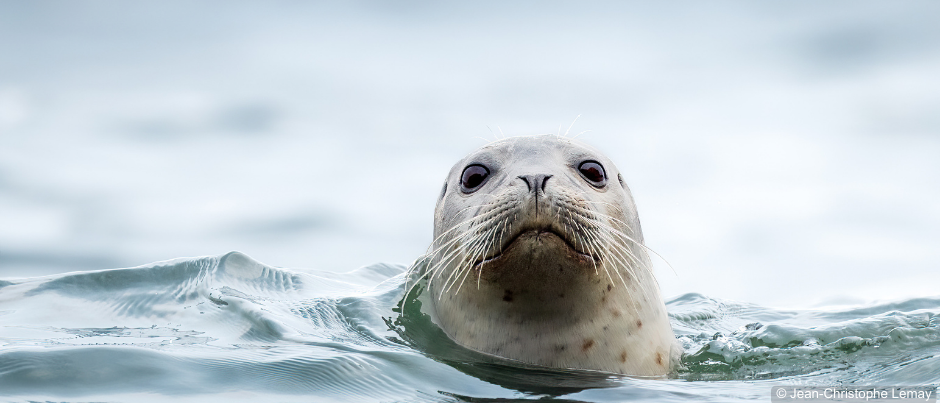
Harbour seals are very common in Bas-Saint-Laurent. They can be seen along the shore in several places, such as in the Rivière-du-Loup area as well as around Île Verte and in Parc national du Bic. You can also encounter this species in Gaspésie and even paddle among these seals in a sea kayak!
In Côte-Nord, you’re more likely to see grey seals. This species is found almost everywhere along the north shore of the St. Lawrence, from Tadoussac all the way to Blanc-Sablon.
The Îles de la Madeleine archipelago is home to four species of seals throughout the seasons. While you’re likely to spot harbour seals and grey seals basking on rocks or sandbanks in the summer, harp seals and hooded seals are more commonly sighted in the winter months.
Where to see moose

The best way to see moose in Eastern Québec is to visit wildlife reserves, particularly the ones in Rimouski, Matane, Port-Daniel and the Chic-Chocs. You may also encounter the king of our forests on a hike while staying at the Auberge de montagne des Chics-Chocs or the Gîte du Mont-Albert hotel.
Where to see white-tailed deer

White-tailed deer can be spotted in nearly all the national parks of Eastern Québec, but particularly in two parks in Bas-Saint-Laurent: Bic and Lac-Témiscouata. You’re also pretty much guaranteed to see this species on Anticosti in Côte-Nord, where it was first introduced in 1896. Today, this island boasts the densest population of white-tailed deer in Québec!
Where to see black bears

Black bears are found throughout the forests of Eastern Québec, but sightings are rare. If you happen to encounter one on a trail, back away slowly while loudly announcing your presence. To observe these mammals safely, it’s best to participate in a supervised bear-watching activity at sites such as the Ferme 5 Étoiles holiday resort or the Essipit vacation centre in Côte-Nord or at the Bioparc, a wildlife park in Gaspésie.
Where to see northern gannets
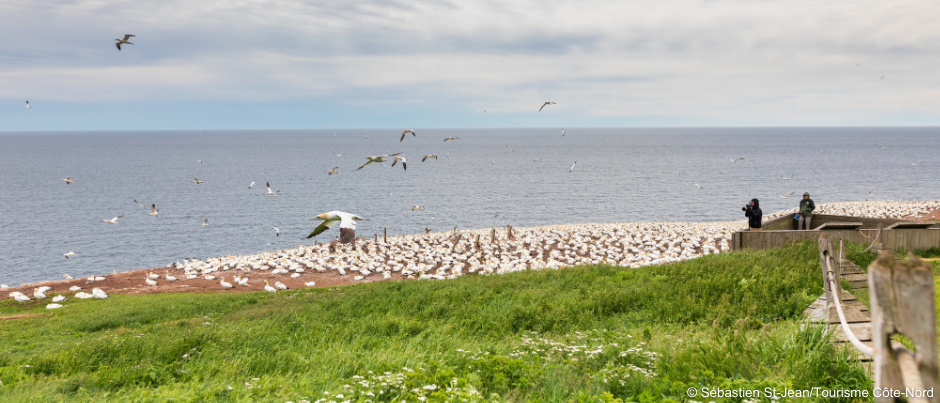
The best place to see northern gannets is Parc national de l’Île-Bonaventure-et-du-Rocher-Percé in Gaspésie: Bonaventure Island is home to the largest colony of these birds in North America, which also happens to be the most accessible in the world. To get there, go on a boat excursion departing from the Percé wharf in the middle of the village. If you’re in the Îles de la Madeleine, you can also participate in a sea excursion that will allow you to admire Rocher-aux-Oiseaux (Bird Rock), an islet that protects North America’s second largest colony of these birds.
Where to see Atlantic puffins

To see Atlantic puffins, you’ll want to visit the Mingan Archipelago National Park Reserve in Côte-Nord. You’ll be charmed by these colourful birds nicknamed “sea parrots”! You can also admire Atlantic puffins in the Îles de la Madeleine if you focus your binoculars on Brion Island.
Where to see hundreds of other species of birds
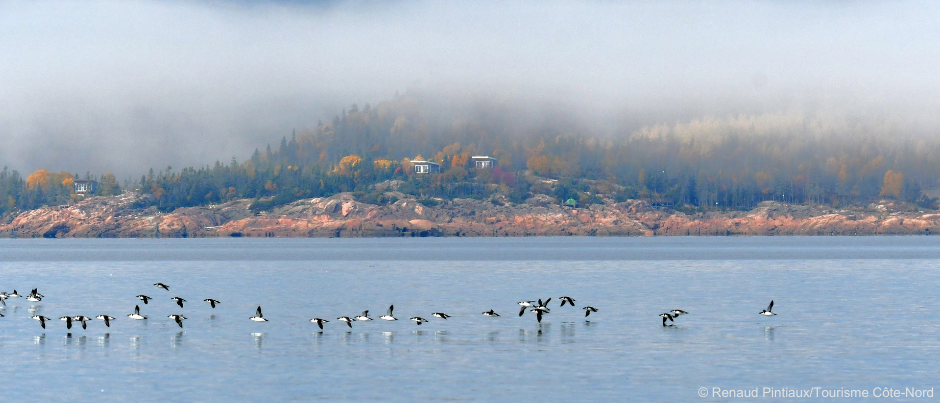
Each of the maritime regions of Québec is home to a multitude of bird species. Here are a few places to add to your itinerary if you’re a bird-watching enthusiast:
- In Bas-Saint-Laurent, large colonies of waterbirds nest on the Pot à l’Eau-de-Vie Islands and on Île aux Lièvres. In Kiskotuk Coastal Park in Cacouna, birds can be observed year-round, including some rare species.
- At the eastern tip of the Gaspé Peninsula, between Gaspé and Percé, the Malbaie Barachois is a popular bird-watching destination that’s home to over 200 species of birds.
- In Côte-Nord, Parc Nature de Pointe-aux-Outardes is an internationally renowned nature park where you can observe at least 255 species of birds, while the Corossol Island Migratory Bird Sanctuary in the Sept Îles Archipelago protects several migratory species, including razorbills. To see nocturnal birds of prey, head to the Tadoussac dunes, where you may be able to spot several species of nesting owls.
- In the Îles de la Madeleine, the Pointe-de-l’Est National Wildlife Area is a favourite spot for bird watching. The ponds and marshes found here are home to a wide variety of bird species throughout the year, but especially during the months of May and June as well as in the fall.
The maritime regions of Québec are great places to observe wildlife. Each region has its own signature species, but no matter where you go, you’ll have opportunities to marvel at the animals you spot at sea, on land and in the air. Start planning your trip now!
If you liked this article, you might also like...
Author Christine Beaudoin

Christine Beaudoin was born in Ottawa and now calls Rimouski home. With a background in marine biology, photography and journalism, she believes that well-told stories connect people. By working with Le Québec maritime, Christine wants to share her love for the maritime regions of Québec with people who dream of visiting this destination.
(0) comment